
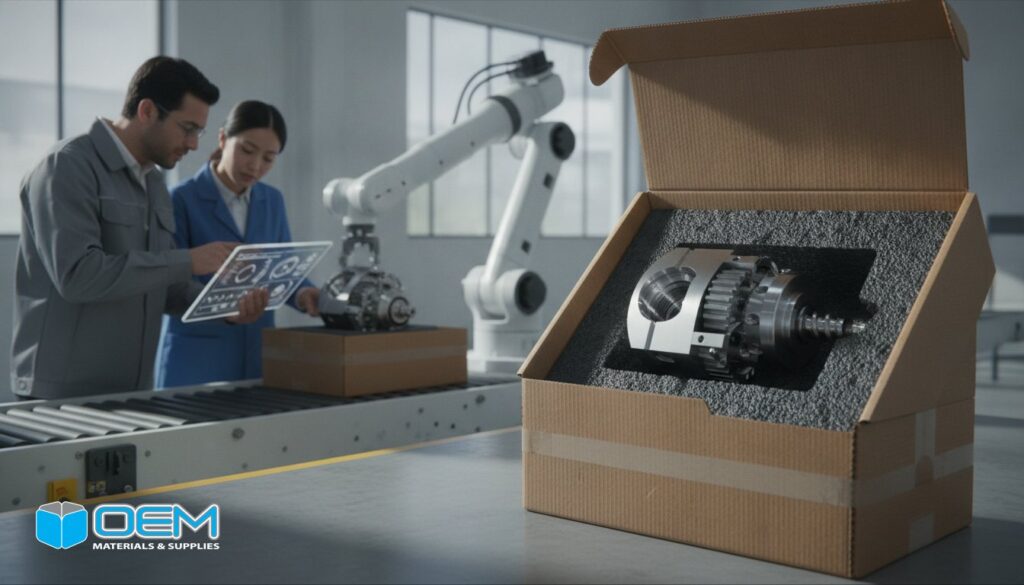
By the start of 2026, a standard corrugated box and a roll of stretch film won’t be enough to protect your margins against rising labor costs and stricter environmental mandates. Staying ahead of industrial packaging trends 2026 requires a shift from viewing packaging as a commodity to treating it as a strategic component of your logistics. You likely already feel the pressure of balancing durable protection with the need for sustainable materials, all while trying to keep transit damage rates at zero.
It’s a difficult balance to maintain when assembly line inefficiencies and long-haul shipping risks continue to climb. This guide analyzes the shifting landscape of industrial materials and logistics to help you optimize your supply chain for 2026. We will examine how precision-engineered foam, custom wood crates, and vendor-managed inventory can lower your operational overhead and ensure compliance with 2026 environmental standards without sacrificing the structural integrity your products require.
Key Takeaways
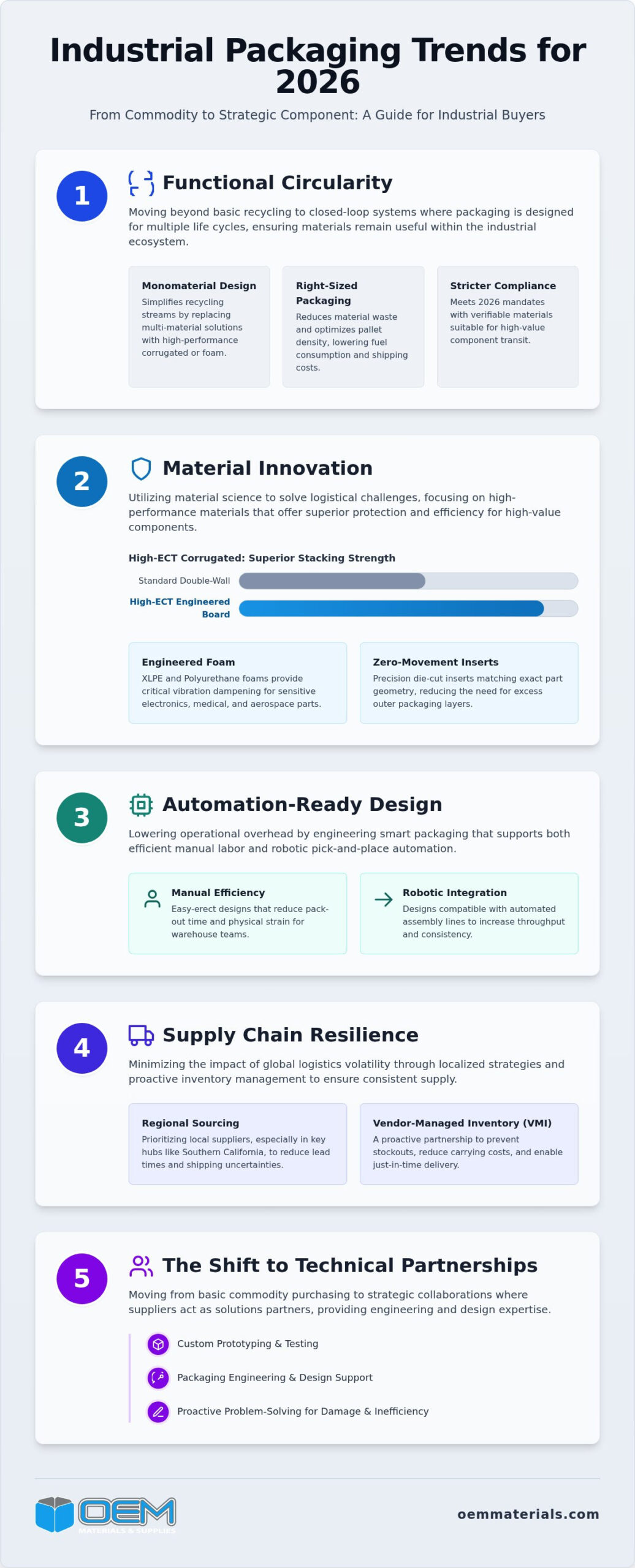
- Learn how functional circularity goes beyond simple recycling by implementing packaging designs intended for multiple life cycles within a closed-loop system.
- Stay ahead of industrial packaging trends 2026 by utilizing high-ECT corrugated board and engineered foam to ensure durability during long-haul transit.
- Identify ways to lower operational overhead by designing easy-erect packaging that supports both manual labor and robotic pick-and-place automation.
- Strengthen your supply chain resilience by prioritizing regional sourcing and vendor-managed inventory (VMI) to minimize the impact of global logistics volatility.
- Understand the shift toward technical partnerships where custom prototyping and engineering support take precedence over basic commodity purchasing.
Beyond Basic Sustainability: The Rise of Functional Circularity in 2026
Functional circularity isn’t just about using recycled paper; it’s about a coordinated system of preparing goods for multiple life cycles within a closed-loop industrial system. In the context of industrial packaging trends 2026, manufacturers are moving away from the use once and discard model. They’re adopting materials that maintain high-strength properties through several recovery phases. This shift ensures that materials don’t just disappear into a landfill but remain useful within the manufacturing ecosystem.
Stricter 2026 standards require materials that are both recyclable and capable of withstanding the rigors of heavy industrial transit. If a corrugated box or wood crate fails during shipping, any sustainability gains from the material are erased by the environmental and financial cost of a damaged product. Right-sizing plays a critical role here. By engineering a container to the exact dimensions of the part, you reduce material waste and optimize pallet density, which directly lowers shipping costs and fuel consumption.
The Transition to Monomaterial Industrial Packaging
Many industrial shipments historically relied on multi-material solutions, such as a corrugated outer shell with plastic foam inserts and metal strapping. These are difficult to process at scale. A major trend for 2026 is the shift toward monomaterial designs. Using a single material type simplifies the recycling stream for warehouse teams. High-performance corrugated designs are now replacing plastic components in many custom packaging designs, using clever folding techniques to provide structural support once reserved for plastic. This transition reduces the labor required to sort waste at the receiving facility.
Regulatory Compliance and Industrial Reporting
Compliance in 2026 is no longer optional or self-reported. Manufacturers face stricter reporting requirements for packaging waste, particularly in high-volume sectors like medical device and aerospace manufacturing. Third-party verification has become the standard for supply chain transparency. Functional circularity is the integration of durability and end-of-life recovery in industrial logistics. This approach ensures your facility meets environmental mandates without risking the safety of high-value components during long-haul transit. By documenting these material choices, purchasing managers can provide the necessary data for corporate sustainability audits while maintaining operational efficiency.
Material Innovation: High-Performance Corrugated and Engineered Foam
Industrial packaging trends 2026 emphasize a move toward material science to solve logistical bottlenecks. For manufacturers of heavy machinery and high-value components, the focus has shifted to high-ECT (Edge Crush Test) corrugated board. Traditional double-wall boxes are being replaced by engineered board grades that offer superior stacking strength without the bulk. This transition allows for safer vertical storage in the warehouse and more efficient palletization during transit, which is critical for maintaining throughput in busy Southern California distribution hubs.
Protecting sensitive payloads requires more than just filling empty space. Aerospace and medical device manufacturers are increasingly relying on cross-linked polyethylene (XLPE) and polyurethane foam inserts for their specific vibration dampening properties. These materials are essential for navigating a market defined by elevated and volatile resin pricing, as they allow for precise protection with minimal material volume. High-performance foam ensures that delicate instrumentation arrives at its destination within calibration, reducing the high costs associated with transit-related returns and repairs. You can find more technical details in our industrial guide to foam inserts.
Advances in Custom Protective Inserts
Precision die-cut foam is becoming the standard for sensitive electronics and automotive components. In 2026, the trend is toward zero-movement packaging where the insert is engineered to the exact geometry of the part. This level of precision reduces the need for excessive outer packaging layers, which can significantly lower your overall shipping weight. It’s a matter of balancing material density with protection requirements. Using a higher density foam often allows for a smaller overall footprint, potentially moving a shipment into a lower freight class. If you’re looking to optimize your current setup, you can request a custom prototype based on your product’s specific dimensions and weight.
Corrugated Strength vs. Weight Optimization
The next generation of industrial corrugated boxes utilizes advanced fiber technology to achieve higher protection levels with lower physical mass. This is particularly relevant for manufacturers in Los Angeles and Orange County who face high shipping costs. Moisture-resistant coatings are also seeing wider adoption in 2026. These coatings prevent the structural degradation of the box in humid environments or during ocean freight, ensuring the integrity of the Edge Crush Test rating remains intact throughout the entire journey. For a deeper look at sourcing these materials, consult our guide on corrugated packaging box manufacturers to understand how modern board grades can improve your bottom line.
Designing for Automation: Reducing Labor Costs Through Smart Packaging
Labor remains the most volatile variable in the manufacturing sector. In 2026, the cost of manual assembly in Southern California facilities continues to drive a shift toward automated fulfillment and robotic integration. Industrial packaging trends 2026 show that packaging design is no longer just about protection; it’s about machine compatibility. Robotic pick-and-place systems require corrugated boxes and foam packaging that feature consistent dimensions and accessible grip points. If a robot can’t reliably grasp a component or its housing, the entire line slows down, leading to costly downtime.
For lines that still rely on human operators, “easy-erect” designs are essential for maintaining high throughput. These designs use auto-locking bottoms or pre-folded scores that eliminate the need for excessive tape or complex folding sequences. This optimization is particularly valuable in San Diego County and Orange County, where facility space and labor rates are at a premium. By reducing the seconds spent on each box, a facility can see a measurable decrease in operational overhead without sacrificing the structural integrity of the shipment.
Kitting and Assembly as a Strategic Advantage
Many manufacturers in Los Angeles County and the Inland Empire are moving toward receiving pre-assembled packaging components. By utilizing custom packaging design that incorporates cushioning materials directly into the box, you remove several steps from your internal process. This reduces warehouse clutter and frees up floor space previously dedicated to storing bulk materials. Receiving integrated packaging kits ensures that every component needed for a shipment is available in one place, which avoids the delays caused by missing inventory or mismatched parts.
Standardization vs. Customization in 2026
Choosing between standard sizes and custom dimensions is a matter of calculating long-term ROI. While stock boxes have lower upfront unit costs, the labor required to add extra dunnage or cut down oversized containers often negates those savings. Custom-sized crates or boxes eliminate the need for secondary void fill and ensure a perfect fit for high-value parts. Rapid prototyping allows engineers to test these designs on automated lines before committing to high-volume production, ensuring the packaging doesn’t cause mechanical jams or sensor errors. Kitting and pre-assembly can significantly reduce internal labor costs by streamlining the final packing process.
Supply Chain Resilience: Local Sourcing and Inventory Management
Global shipping volatility has forced a fundamental rethink of procurement strategies. Relying on international lead times is no longer a viable risk for high-volume manufacturers. Industrial packaging trends 2026 reflect a decisive shift toward regional sourcing to mitigate these disruptions. For facilities in Los Angeles, Orange County, and San Diego, proximity to a packaging partner isn’t just a convenience; it’s a necessity for maintaining production uptime. When a critical component shipment is delayed, having a local supplier who can pivot and provide immediate corrugated boxes or custom foam packaging prevents a total line stoppage.
Stability in 2026 is defined by the reliability of your material flow. Moving away from overseas vendors reduces the carbon footprint of your logistics and eliminates the uncertainty of port congestion. Localized supply chains allow for more frequent, smaller deliveries that align with actual production needs. This responsiveness is the cornerstone of a resilient operation that can adapt to sudden market shifts without carrying months of expensive safety stock.
The Strategic Value of Vendor-Managed Inventory
Strategic inventory management is the most effective hedge against market instability. Implementing packaging VMI prevents stockouts of critical shipping supplies by moving the burden of inventory tracking to the supplier. Instead of your purchasing manager manually checking levels of stretch film or edge protectors, automated replenishment programs ensure materials are delivered before they reach a critical low. This reduces the administrative burden on your team and ensures that your facility in Southern California has the rapid response capability needed for unforecasted demand spikes.
Managing Warehouse Space in High-Cost Regions
Space is a premium commodity in Southern California. Manufacturers in high-cost regions must maximize every square foot of their facility. Using flat-packed corrugated and efficient pallet stacking allows you to store more protection in a smaller footprint. However, a significant trend for 2026 is the use of just-in-time (JIT) delivery and off-site stock holding. By utilizing distribution hubs in Riverside and the Inland Empire, you can keep bulky materials like wood crates and plastic pallets off your main production floor until the exact moment they are needed. This approach turns your warehouse into a high-velocity throughput center rather than a storage locker for packaging materials. If you are ready to stabilize your material availability and reclaim warehouse space, contact us for a VMI consultation to see how a regional logistics plan can protect your operations.
Strategic Partnerships: Implementing 2026 Packaging Solutions
Selecting a vendor in 2026 requires looking beyond the price per unit. The industrial packaging trends 2026 highlight a shift toward technical support and design consultation over simple order fulfillment. An experienced partner acts as a consultant, helping you refine your custom packaging design to meet specific transit requirements. This is especially vital for manufacturers in aerospace and medical sectors where the margin for error is zero. For more on this selection process, refer to our guide on choosing a wholesale industrial packaging supplier.
A reliable partnership is defined by its ability to solve logistical problems before they impact your bottom line. Whether you’re operating out of Orange County or the Inland Empire, you need a supplier that understands the nuances of high-volume production. Technical expertise in material science allows a partner to recommend the exact foam packaging density or corrugated board grade to protect your specific components. This consultative approach ensures that your packaging is engineered for performance rather than just being a generic container.
Auditing Your Current Packaging Strategy
The first step toward optimization is a comprehensive audit of your current system. Identify material waste by looking for over-packaging; if you’re using excessive cushioning materials for a lightweight part, you’re paying for unnecessary volume. Evaluating damage rates is equally important to determine if protection levels are adequate for long-haul transit. Using data-driven recommendations, you can select new corrugated or foam specs that align with the actual risks of your shipping lanes. This process eliminates guesswork and ensures every dollar spent on packaging contributes to product safety.
Transitioning to an Integrated Supply Model
Consolidating multiple packaging categories under one supplier simplifies your procurement process and improves supply chain visibility. By managing corrugated boxes, stretch film, and wood crates through a single point of contact, you establish clear KPIs for lead times and material quality. This integrated model reduces the administrative burden on your purchasing team and allows for better coordination of just-in-time delivery schedules. To receive a tailored recommendation for your facility, please provide your product dimensions, weight, and annual usage for a custom quote and design consultation.
Preparing Your Operations for 2026
The shift toward functional circularity and high-performance materials is no longer a distant projection; it’s a current requirement for maintaining a competitive edge. Generic solutions are no longer sufficient for complex logistics. Adapting to industrial packaging trends 2026 means moving away from standard catalog items and embracing engineered protection that supports both robotic automation and regional supply chain resilience. By integrating custom foam inserts and high-ECT corrugated board, you can effectively reduce product damage while lowering total operational overhead.
OEM Materials & Supplies serves aerospace and medical manufacturers across Southern California with specialists in custom corrugated and engineered foam solutions. Prototyping is available for high-volume production programs to ensure a perfect fit before you scale. Whether you operate in Orange County, Los Angeles, or the Inland Empire, our team provides the technical expertise and inventory management services needed to stabilize your material flow. Contact OEM Materials & Supplies for a custom packaging consultation or quote. Please provide your product dimensions, weight, and annual usage to help us develop the most efficient solution for your facility. We look forward to helping you build a more resilient supply chain.
Frequently Asked Questions
What are the most durable industrial packaging materials for 2026?
High-ECT corrugated board and cross-linked polyethylene (XLPE) are the primary durable materials for industrial packaging trends 2026. These materials provide the structural integrity needed for heavy machinery while remaining compatible with modern recycling streams. XLPE is valued in the aerospace and medical sectors for its closed-cell structure, which resists moisture and chemicals during transit. Combining these with custom wood crates ensures maximum protection for high-value industrial assets throughout the supply chain.
How does custom foam packaging reduce shipping costs?
Custom foam packaging reduces costs by optimizing the dimensional weight of your shipments and eliminating the need for excessive void fill. When an insert is engineered to the exact dimensions of your product, the overall box size can often be reduced. This optimization potentially moves the shipment into a lower freight class. Additionally, a precision fit significantly lowers damage rates, which reduces the administrative and logistical expenses associated with product returns and replacements.
What is the benefit of using a local packaging supplier in Southern California?
Partnering with a local supplier in Southern California provides immediate access to just-in-time delivery and vendor-managed inventory services. Manufacturers in Los Angeles, Orange County, and San Diego benefit from reduced lead times and lower freight costs for bulky packaging supplies. Proximity allows for faster response to unforecasted demand spikes and enables on-site design consultations. These local touchpoints are critical for developing complex prototypes for high-volume production programs.
Can corrugated boxes replace wood crates for heavy industrial parts?
High-performance corrugated boxes can replace wood crates for certain heavy industrial parts, provided the ECT rating matches the stacking requirements. While wood crates remain the standard for extremely heavy or oversized machinery, advanced triple-wall corrugated designs offer a lightweight alternative that reduces shipping costs and simplifies disposal. However, specific export regulations or maximum load capacities may still require the structural rigidity of heat-treated wood crates or heavy-duty plastic pallets.
How does Vendor-Managed Inventory (VMI) work for packaging supplies?
Vendor-Managed Inventory (VMI) involves the supplier monitoring your stock levels and automatically triggering replenishment orders. This system removes the administrative burden of manual inventory tracking from your purchasing team. By maintaining a consistent flow of corrugated boxes, stretch film, and cushioning materials, VMI prevents stockouts and stabilizes your supply chain. It’s an effective solution for space-constrained warehouses in Riverside and the Inland Empire that need to maximize their floor space.
What is the expected lead time for custom corrugated prototypes in 2026?
The expected lead time for custom corrugated prototypes in 2026 generally ranges from 48 to 72 hours for standard designs. Rapid prototyping capabilities allow engineers to test the fit and function of a container before committing to high-volume production. This speed is essential for manufacturers in fast-moving sectors like electronics and medical devices. Factors such as the complexity of die-cut features or the integration of custom foam inserts can influence the final delivery schedule.
How do I choose between polyethylene and polyurethane foam for electronics?
Choosing between polyethylene (PE) and polyurethane (PU) foam depends on the weight and sensitivity of your electronics. Polyethylene is a denser, closed-cell foam ideal for providing structural support and surface protection for heavier components. Polyurethane is a softer, open-cell foam better suited for vibration dampening and protecting lightweight, delicate instruments. Our design team evaluates your product’s fragility and weight to recommend the specific density required for safe transit and long-term storage.
What are the standard export requirements for industrial pallets in 2026?
Standard export requirements for industrial pallets in 2026 continue to focus on ISPM 15 compliance for wood products. All wood crates and pallets must be heat-treated and stamped to prevent the spread of pests across international borders. Many manufacturers are switching to plastic pallets to bypass these treatment requirements entirely. Plastic options offer a durable, moisture-resistant alternative that is exempt from ISPM 15 regulations, making them a preferred choice for global shipping programs.