

A warehouse full of corrugated boxes is often viewed as a safety net, but in reality, it is a stagnant capital investment that consumes valuable floor space. Most operations managers understand the frustration of halting a production line because a specific custom foam insert or a specialized shipping carton is missing from the shelf. Manual tracking and bulky inventory storage frequently lead to high carrying costs and avoidable rush orders that erode profit margins.
This guide provides a technical roadmap for managing packaging supply inventory to ensure your shipping department never becomes a bottleneck for your manufacturing output. You will learn how to optimize your supply chain, reduce warehouse overhead, and eliminate stockouts through professional management strategies. We focus on practical remedies that solve the logistical challenges inherent in high-volume distribution and complex assembly.
We will examine how manufacturers in Orange County and throughout Southern California utilize vendor managed inventory (VMI) and just-in-time (JIT) delivery to shrink their warehouse footprints. This transition from reactive ordering to strategic replenishment reduces labor costs associated with manual counts and provides the predictable supply levels required for the aerospace, medical, and automotive sectors.
Key Takeaways
- Identify hidden costs such as obsolete materials and emergency shipping fees that stem from uncoordinated inventory tracking.
- Apply ABC analysis for managing packaging supply inventory to ensure high-priority items like custom corrugated boxes never cause production delays.
- Utilize physical organization techniques and First-In, First-Out protocols to maintain material integrity and reduce your warehouse footprint.
- Leverage Vendor-Managed Inventory programs to shift the burden of stock monitoring and replenishment to a trusted industrial supplier.
- Evaluate potential partners based on their proximity to Southern California hubs to minimize lead times and logistical expenses.
Why Packaging Inventory is a Critical Cost Center for Manufacturers
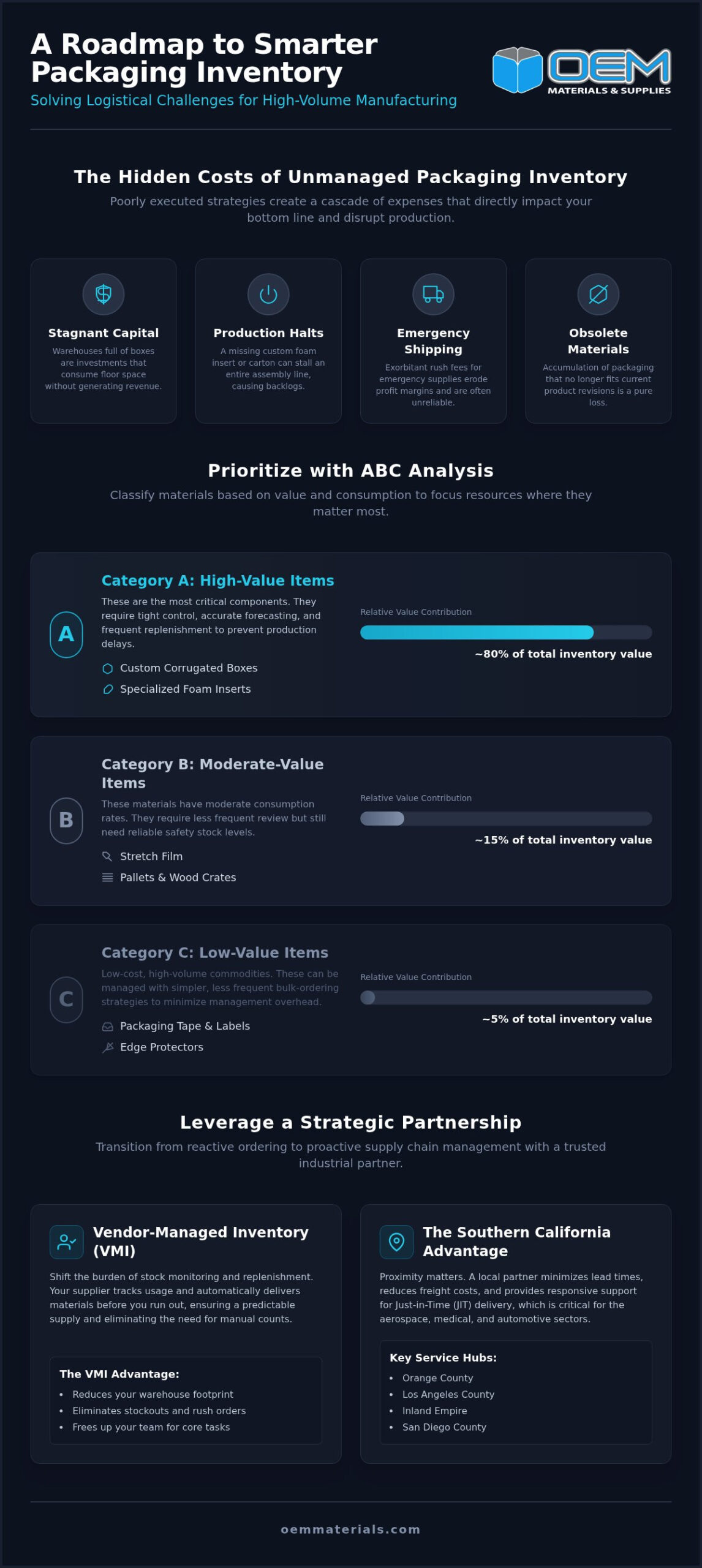
Packaging inventory management is the technical coordination of storage, tracking, and replenishment of all materials required to protect and ship industrial goods. It’s far more than just keeping boxes on a shelf. Poorly executed strategies for managing packaging supply inventory create a cascade of hidden costs that directly impact the bottom line. These include frequent stockouts that stall production, exorbitant rush shipping fees for emergency supplies, and the accumulation of obsolete materials that no longer fit current product revisions.
When packaging is managed as an afterthought, it consumes excessive floor space and disrupts downstream manufacturing schedules. A delay in receiving specialized cushioning or crates doesn’t just slow down the shipping department; it creates a backlog that affects the entire assembly line. Professional inventory management is required to ensure that packaging remains a facilitator of commerce rather than a logistical hurdle.
The True Cost of Warehouse Space in Southern California
In regions like Orange County, Los Angeles, and San Diego, industrial real estate prices are among the highest in the nation. Storing bulky items like large pallets or stacks of corrugated boxes in these facilities carries a high price tag. Every square foot dedicated to empty boxes is a square foot that cannot be used for revenue-generating machinery or finished goods production. Carrying cost represents the total expense of holding inventory, including storage fees, insurance, and the interest on capital used to purchase the materials. Professionals must weigh the cost of bulk purchasing discounts against the high overhead of local storage.
Risks of Inadequate Safety Stock Levels
Maintaining the right balance of safety stock is a delicate technical challenge. Standard lead times for custom materials are often predictable, but emergency replenishment cycles are costly and unreliable. If a single component, such as custom foam packaging, is missing, the entire shipping line halts regardless of how many finished products are ready for transport. This disruption often leads to missed delivery windows and strained customer relationships.
This reality often triggers the bullwhip effect in packaging procurement. A small fluctuation in customer demand leads to over-correction in order volumes, resulting in either severe shortages or massive overstocks. Precise data is necessary to smooth out these fluctuations and maintain steady production flow without the risks associated with inadequate safety stock. Managing packaging supply inventory effectively means anticipating these shifts before they impact the warehouse floor.
Categorizing Materials Using ABC Analysis and Demand Forecasting
Effective strategies for managing packaging supply inventory often begin with a rigorous classification of materials based on their value and consumption rates. Implementing an ABC Analysis allows procurement teams to prioritize their focus where it impacts the bottom line most significantly. In an industrial setting, this prevents over-investment in low-value commodities while ensuring critical components are always available for the production line.
- Category A: These are high-value or high-velocity items that require tight control and frequent replenishment. This typically includes custom corrugated boxes and specialized foam inserts that are essential for specific product lines.
- Category B: Materials with moderate consumption rates, such as stretch film and pallets. These require less frequent review but still necessitate reliable safety stock.
- Category C: Low-cost, high-volume items like packaging tape, edge protectors, or standard mailing tubes. These can be managed with simpler bulk-ordering strategies.
Relying on historical data is vital for predicting seasonal spikes or project-based requirements. By analyzing past usage patterns, manufacturers in the Inland Empire and Orange County can anticipate when demand for specific shipping containers will surge, allowing for proactive procurement rather than reactive scrambling. If you are unsure how your current stock fits these categories, you can request a professional inventory audit to streamline your ordering cycles.
Setting Accurate Reorder Points and Safety Stock
Managing packaging supply inventory successfully requires a mathematical approach to replenishment. A standard reorder point is calculated by multiplying the lead time by the average daily usage and adding a safety stock buffer. For custom-engineered materials, lead times are often longer and less flexible than for stock items, requiring a larger safety stock to mitigate supply chain volatility. It’s a common mistake to overstock “just in case,” but this strategy fails because it clogs warehouse aisles and ties up liquid capital in stagnant cardboard.
SKU Rationalization Through Custom Design
One of the most effective ways to simplify inventory is through SKU rationalization. Professional custom packaging design can often consolidate several different box sizes into a single, universal multi-depth box. Similarly, modular foam inserts can be engineered to protect multiple product variations, reducing the total number of unique parts you must track. Reducing your SKU count directly lowers labor costs associated with inventory counting and simplifies the procurement process for your purchasing department. This technical approach transforms packaging from a series of individual items into a cohesive, manageable system.
Optimizing Warehouse Storage and Usage Tracking Protocols
Physical organization is the foundation of efficiency on the warehouse floor. When managing packaging supply inventory, every minute spent searching for a specific crate or roll of tape is lost productivity. A high-functioning facility organizes materials based on frequency of use and physical characteristics. Heavier items like plastic pallets belong on lower racking levels, while lighter corrugated components can be stored higher. Implementing a First-In, First-Out (FIFO) protocol is non-negotiable for items with a shelf life. Adhesives, packaging tapes, and certain films can lose their technical properties over time; using the oldest stock first ensures material integrity and reduces waste.
Real-time tracking through barcode or RFID systems provides the visibility needed to prevent stockouts. Digital records are only as good as the data entered, so regular physical audits remain essential. Discrepancies between digital counts and physical stock often reveal systemic issues in usage reporting or damaged goods handling. Verifying these records monthly or quarterly maintains the accuracy required for high-precision sectors like medical device manufacturing. Accurate tracking ensures that the procurement team has a clear view of actual consumption versus forecasted needs.
Point-of-Use Storage and Load Stabilization
Storing materials like stretch film directly at the wrapping station eliminates unnecessary internal transit. This point-of-use strategy reduces labor costs and keeps the shipping line moving at a consistent pace. For technical details on maximizing material performance during this stage, refer to our industrial guide to stretch film. Proper organization ensures that stabilization tools are always within reach, preventing the shortcuts that lead to product damage during transit. Reducing search time for warehouse staff directly translates to higher throughput in the distribution center.
Kitting and Assembly as an Inventory Strategy
Kitting involves pre-assembling multiple components, such as boxes, custom foam inserts, and labels, into a single unit before they reach the final packing line. This approach simplifies managing packaging supply inventory by allowing procurement teams to track one kit SKU instead of five individual parts. Kitting significantly reduces the physical footprint of materials on the assembly floor, as workers only have the exact items they need for a specific production run. By moving the bulk storage of individual components to a designated kitting area or utilizing a partner’s off-site assembly services, manufacturers in Los Angeles and San Diego can reclaim valuable production space. This strategic consolidation minimizes the complexity of cycle counts and ensures that every component is ready for immediate use.
Leveraging Vendor-Managed Inventory (VMI) to Reduce Operational Overhead
Vendor-Managed Inventory (VMI) is a technical arrangement where the supplier takes full responsibility for monitoring stock levels at the customer facility and triggering replenishment orders. This shift fundamentally changes how a company approaches managing packaging supply inventory. Instead of internal teams spending hours on manual counts and paperwork, the supplier maintains the agreed-upon stock levels based on real-time usage data. This transition from a transactional purchasing model to a strategic partnership model allows your procurement department to focus on high-level supply chain strategy rather than the minutiae of box counts.
Implementing VMI significantly reduces administrative labor. The constant cycle of generating, approving, and tracking individual purchase orders for dozens of different SKUs is replaced by a consolidated, automated process. This reliability is essential for high-stakes industries like aerospace and medical device manufacturing, where a missing component can have severe downstream consequences. By integrating your supplier into your inventory workflow, you ensure that technical expertise is applied to your replenishment cycles, preventing the common human errors associated with traditional ordering.
Comparing Manual Management vs. VMI Programs
Manual management relies on periodic physical counts and reactive ordering, which inherently increases the risk of stockouts during unexpected production spikes. VMI programs mitigate this risk by using consistent monitoring to ensure replenishment occurs well before stock reaches a critical floor. There is also a major impact on cash flow. In many VMI models, manufacturers pay for materials only as they are pulled for use on the assembly line. This eliminates the financial burden of carrying months of “dead capital” in the form of stagnant corrugated inventory or bulky foam inserts.
Just-In-Time (JIT) Delivery for Bulky Supplies
For manufacturers in high-rent districts across Orange County, Los Angeles, and the Inland Empire, warehouse space must be utilized for production, not storage. JIT packaging services allow for smaller, more frequent deliveries that align perfectly with your weekly production schedule. This approach is particularly effective for bulky items like plastic pallets, large wood crates, and oversized corrugated containers that consume massive amounts of floor space. By receiving these items only when they are needed for immediate shipping, you maintain a lean facility and reduce the risk of material damage that occurs during long-term storage. If you’re looking to reclaim floor space and improve your operational efficiency, you can consult with a VMI specialist to analyze your current usage rates and design a custom replenishment program.
Selecting a Strategic Packaging Partner in Southern California
Choosing a wholesale industrial packaging supplier is a decision that extends far beyond unit pricing. For manufacturers in San Diego, Los Angeles, and Orange County, local proximity is a critical logistical advantage. A partner situated within the region provides faster response times for emergency orders and more frequent Just-In-Time deliveries, which are essential for managing packaging supply inventory without clogging your warehouse. Local support also means that specialists can perform physical site visits to verify stock levels, ensuring the accuracy of your replenishment cycles.
Technical expertise is another non-negotiable factor, particularly for those operating in specialized sectors like medical devices, electronics, or aerospace. Your supplier must understand the rigorous protection standards required for sensitive components. A partner that offers both custom manufacturing for specialized foam or corrugated solutions and a robust catalog of stock supplies provides the flexibility needed to scale operations. This dual capability ensures that as your product line evolves, your packaging infrastructure can adapt without the need to onboard additional vendors.
Evaluating Supplier Capabilities Beyond the Catalog
A strategic partner should offer in-house design and prototyping services to help you refine your packaging before committing to high-volume production. This capability allows you to test custom foam inserts or corrugated structures against actual product dimensions and weights. You should also assess their ability to scale; a provider that excels at small-batch prototypes but struggles with large production runs will eventually become a bottleneck. Look for value-added services like kitting and assembly, which move labor-intensive tasks off your floor and into a controlled environment where efficiency is the primary focus.
Initiating an Inventory Audit and Quote Request
The first step toward a more efficient supply chain is a professional inventory audit. To provide an accurate recommendation, a specialist will need specific data points, including product dimensions, weights, and projected annual usage. This information allows for a technical analysis of your current workflow to identify cost-saving opportunities, such as SKU consolidation or material optimization where appropriate. A consultation focuses on solving real-world problems like product damage or excessive storage costs. Requesting a quote with these technical details is the most direct way to transition from a reactive purchasing model to a strategic system for managing packaging supply inventory.
Transitioning to a Strategic Packaging Infrastructure
Effective oversight of your shipping materials requires moving beyond manual counts and reactive ordering. By implementing technical categorization like ABC analysis and utilizing point-of-use storage, you transform a cost center into a streamlined operational asset. Reducing SKU complexity through custom design and kitting further minimizes the warehouse footprint of bulky corrugated boxes and foam inserts. These strategies ensure that your facility remains focused on production rather than the logistics of empty containers.
Successful execution depends on a partner that offers both technical manufacturing and local logistics support. OEM Materials & Supplies provides custom VMI programs tailored to the specific needs of Southern California manufacturers in the aerospace, medical, and electronics sectors. Our local delivery network ensures consistent supply across Orange County, Los Angeles, and San Diego, allowing you to focus on manufacturing output rather than stock levels. Managing packaging supply inventory doesn’t have to be a source of production delays or high carrying costs.
Take the first step toward a lean, predictable supply chain by providing your product dimensions, weight, and annual usage for a professional recommendation. Request a Quote for Managed Packaging Inventory Solutions to optimize your facility today. We look forward to helping you build a more resilient shipping operation.
Frequently Asked Questions
What is the difference between VMI and JIT in packaging?
VMI focuses on the responsibility of replenishment, while JIT focuses on the timing of deliveries. In a VMI model, the supplier monitors your stock levels and triggers orders automatically. JIT delivery focuses on receiving materials exactly when they are needed for production to minimize storage. Both strategies are often used together to optimize a supply chain, particularly for bulky items like plastic pallets or large corrugated containers.
How often should I conduct a physical audit of my packaging supplies?
You should conduct a physical audit of your packaging supplies at least once a month for high-velocity items and once a quarter for slower-moving materials. Regular audits are necessary to verify that your digital inventory records match the actual stock on your warehouse floor. These checks help identify systemic issues like unreported damage or usage tracking errors. Maintaining this accuracy is a critical component of managing packaging supply inventory.
Can I use VMI for custom-branded corrugated boxes?
VMI is an ideal solution for custom-branded corrugated boxes because these items often have longer lead times than stock supplies. A VMI program ensures that your specific branded inventory is always available by tracking consumption and initiating production cycles well in advance. This prevents the risk of stockouts that could halt your shipping department. By delegating this task to a partner, you ensure that your custom packaging is managed with technical precision.
How do I calculate the safety stock for high-volume shipping materials?
Safety stock is calculated by determining the difference between your maximum daily usage and lead time versus your average usage and lead time. This buffer protects your production line from unexpected spikes in demand or supply chain disruptions. For custom foam packaging or specialized crates, you should maintain a larger buffer due to longer replenishment cycles. Accurate safety stock levels prevent the high costs associated with emergency rush orders and production downtime.
What are the common signs that my packaging inventory management is failing?
Common signs of failure include frequent production delays caused by missing components, high expenditures on rush shipping fees, and an overflowing warehouse of obsolete materials. If your team is constantly performing manual counts to resolve discrepancies, your current system is inefficient. Managing packaging supply inventory effectively should result in predictable stock levels and a minimal warehouse footprint. When your shipping department becomes a bottleneck for manufacturing, it is time to evaluate professional management strategies.
How does SKU rationalization help with warehouse space?
SKU rationalization reduces the number of unique items you must store by creating universal packaging designs that fit multiple products. For example, using multi-depth boxes or modular foam inserts can replace several specialized containers with a single SKU. This consolidation reclaims valuable warehouse space and simplifies the procurement process. Fewer SKUs lead to more accurate inventory counts and lower labor costs, allowing your operations team to focus on high-value manufacturing tasks.
Is automated inventory tracking worth the investment for small manufacturers?
Automated inventory tracking is a valuable investment for small manufacturers because it eliminates the human errors that lead to costly stockouts. While the initial setup requires time, the long-term savings from reduced labor and eliminated emergency orders are significant. Automation provides the precise data needed to scale your operations and eventually transition to a VMI model. Even basic barcoding systems improve accuracy enough to justify the technical shift in your warehouse tracking protocols.
What data should I provide to a supplier for an accurate VMI quote?
To receive an accurate VMI quote, you should provide detailed data on product dimensions, material weights, and projected annual usage for each SKU. It is also helpful to share your current lead times and any specialized requirements, such as ESD protection or cleanroom standards. This information allows a supplier to design a replenishment cycle that matches your actual production rhythm. Providing precise historical data ensures that your VMI program is built on a realistic operational foundation.